Thursday, July 7, 2016

Memphis TN Vacation– 5th Day – 6/15/2016 (Mr. Kim’s comments in italics)


This was a bit of a somber day, but one I wouldn’t have missed for anything. 

We started off by trying to go to Roxie Grocery, a breakfast spot that was recommended to us by The Child.  But it was padlocked and clearly not opening any time soon.  So we ended up going back to The Cupboard for a delicious breakfast.  It’s funny – I almost never eat breakfast at home.  I am usually just not in the mood.  But on vacation, I always want breakfast – a big one with eggs, pig-something, grits and biscuits!  Even at the beach, where it’s hot and you’d think all I’d want is maybe fruit and toast.  

The majority of our day was spent at the National Civil Rights Museum at the Lorraine Motel.  The Lorraine Motel is the place where Dr. Martin Luther King, Jr. was assassinated in 1968, just 2 months before Bobby Kennedy.  I remember that terrible year and those events even though I was only 9.  We lived in Alexandria, VA, just outside of Washington, DC.  The day after Dr. King was killed the riots started in Washington.  I remember my mother calling from work that afternoon and saying that she might be late because of the ‘trouble’.  She didn’t have a car and the bus system was disrupted.  I think she ended up getting a ride home from someone, but she was still late.  I was so frightened and confused.  My mom, unlike the rest of her family, was a Democrat and pretty liberal and that was how she was raising me.  I knew about the problems that our country faced with regards to race (at least as much as a child could) and I knew about Dr. King.  I was too young to remember the March on Washington, but knew about and was stirred by his “I have a dream” speech.  I knew about non-violence and couldn’t understand why people were being violent when they were sad about Dr. King.  I was much too young to understand frustration and what years of being mistreated and oppressed can do to a person.  As an adult, I can conceive it, but, being white, I can’t really KNOW it. 

Years later, in high school, I did a year-long term paper on Three Pacifist Leaders in History: Jesus Christ, Mahatma Gandhi and Martin Luther King, Jr.  I really researched, for the first time, the history of race in America and the miracle of Dr. King and the Civil Rights movement.  It opened my eyes and broke my heart, both that people could be so cruel to their fellow man and that Dr. King and the non-violence movement could exist in the midst of so much hate.  I learned of recent lynchings (and for the first time, realized the meaning of the song “Strange Fruit”), of the Ku Klux Klan (which I had thought was pretty much moribund) and of what could be accomplished when people got together and said “this must stop”.  I was astounded by the courage of the people in the movement.  And by the courage of Dr. King, who knew he was a target and even spoke about not being here for the journey. 

I should say that there are two periods of history that disturb me to the point that I avoid reading about them or watching movies or TV programs about them.  Those are the Holocaust and the years leading up to the Civil Rights movement.  Even thinking about these times causes extreme anxiety and so, childishly, I tend to evade them.  I haven’t seen the Holocaust museum in Washington yet, even though it has been open since 1993 and I’ve been up there numerous times.  I haven’t even been to the one in Richmond VA – WHERE I LIVE.  So, as you can imagine, going to the Civil Rights museum, the actual spot where one of my heroes was killed was not high on my vacation wish list.  But I knew that I needed to go, that it was an important place – both historically and to me. 


Before we even got to the museum, we sighted this Historical Marker nearby.  It set the somber tone:

If the day before I’d wandered through Stax with a smile on my face, this day I walked through the museum clutching a tissue with tears running down my face.  Mr. Kim and I hardly spoke to one another – we each went at our own pace and came together occasionally.  And we took hardly any pictures.   Neither did anyone else.  I snapped one in the first gallery, but the tone and mood of the place quickly penetrated.  Taking pictures here would be as appropriate as taking them at a funeral. This is the sign at the motel and a picture of the motel balcony with a permanent wreath:

I can’t see that balcony without seeing the image of everyone one it pointing to where the shot had come from and Dr. King crumpled on the cement. 

The museum is truly a wonder and a national treasure.  The museum encompasses the motel, including a glassed in walk-through of his actual room set up how it must have looked that evening.  Attached to that is the real ‘museum’ part with incredible exhibits spanning the history of African-Americans and the civil rights struggle in this country.  Starting in Africa and going up through the present day, including human trafficking and child labor and female rights suppression across the world.  To say that it is complete and awe inspiring is not enough.  Nothing that I could say would explain the impact of it.  Every single person in the US should tour it and experience it. 

The other part of the complex includes the rooming house where the fatal shot came from.  This building is filled with exhibits detailing the search for the shooter and subsequent investigations.  Seeing that room, set up to look exactly like it looked the day that James Earl Ray aimed at Dr. King is heartrending.  The evil that people are willing to do from fear and prejudice is horrifying. 

It takes about four hours to really walk through it and look at everything.  Think of that – there was so much to see and read and experience within the confines of a small motel’s shell.  It was exceptionally well planned out, neither preachy nor incendiary, though this could easily have been either.  The museum ends as many do – with a path through the gift shop.  As with the photos, I couldn’t see profaning the place by walking out with an MLK I have a dream t-shirt or a wall plaque of a burned out bus.  We did buy an illustrated book on the museum itself for later viewing.  Most everyone was somber and reflective after the walk-through.

And then we went to dinner.  It is a little ridiculous how quickly the mundane follows the profound, huh?  But that’s the way life works.  Dr. King’s motel room had newspapers strewn around, half-filled coffee cups and overflowing ashtrays.  A life to get back to when he stepped back into his room.  Except he didn’t – and life changed for so many. 


Dinner was at Payne’s BBQ:
This place was highly recommended by the folks at Chowhound.com.  Just a neighborhood joint like so many of the places that we went to.  These places are the kind that the South abounds in.  Little places that seem to be hardly worth a glance, a bit shabby and in sketchy neighborhoods.  But if you take a chance, you are likely to find something truly special.  We certainly did at Cozy Corner and we did again this day at Payne’s.  “Where’s my BBQ?”:

I had to try the tamale:
I grew up eating canned Hormel tamales.  Everyone in my mom’s family ate them.  I didn’t know anyone else that liked them, or even knew what they were.  My mother’s family only.  This made no sense to me – we were of Italian extraction and they all were brought up in the South – the Mississippi Delta region, NOT Texas or Arizona.  When I grew up and started learning about food and food culture, I finally put it together.  Tamales are a HUGE thing in the Delta.  There are lots of theories as to why, but it seems that tamales have been part of the Delta food culture since at least the 1920’s.  The Delta includes towns like Clarksdale, Rosedale and Shelby - towns that I grew up hearing about.  THEN I got it.  Turns out that those canned ones are a little mild.  This tamale was a LOT meatier and a good bit spicier than the canned ones.  It was delicious, but I couldn’t finish it!  We also went for a chopped sandwich and ribs:
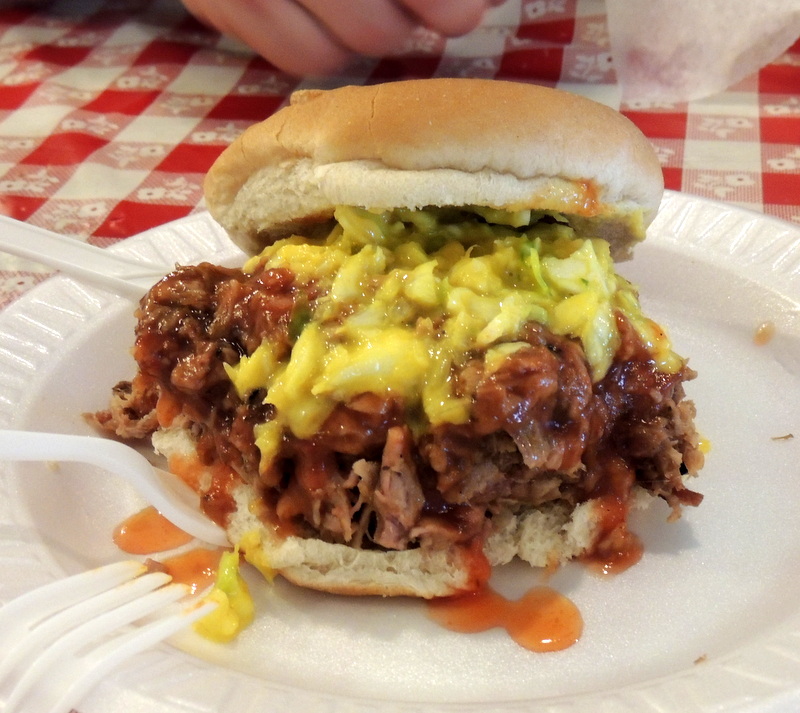
The sauce was fantastic.  Almost as good as Cozy Corner’s.  And the mustard slaw is one of our favorites, too.  We discovered mustard slaw at a little cement block box of a place somewhere in NC and fell in love.  It is the perfect BBQ slaw.  The ribs were gorgeous – meaty, fatty and porky!  That is a half portion!  We were still eating it when we got home (NEVER travel without a cooler!).  We found these cookies at Payne’s and also at a little corner store we stopped at for drinks:
I wish I’d bought a case.  I figured if they were made by somebody’s momma, they’d be good.  Check out that ingredient list: flour, sugar, butter, vanilla and baking soda.  They were the perfect, simple cookie – deep butter and vanilla flavor and crisp! 

We made one more stop, this time in downtown at the Cake Gallery.  Kim was doing her pre-shopping to plan on what we would come back for as we were leaving town.  This boutique appears to serve sandwiches and light lunches (we were not there at the right time for this) and delightful layer cakes in interesting flavors.  Kim made mental notes on what to buy later, and picked up some cookies for our long drive back to the hotel in Arkansas (about 5 miles away.)


Back to the hotel to organize and pack up.  We are sorry to leave Memphis – we truly fell in love with the city and hope we get to come back sometime!


Thursday, June 30, 2016

Memphis TN Vacation– 4th Day – 6/14/2016 (Mr. Kim’s comments in italics)


Breakfast at the Arcade Restaurant:
The oldest cafĂ© in Memphis – established in 1919:


Gorgeous breakfasts:

Those are their famous pumpkin pancakes.  Despite being in the South, the hash browns were delicious!  And yet more grits:

Just across the street is Central Station:
It was built in 1914 and for years WAS the central train station for Memphis.  It now houses meeting rooms, a ballroom, condos and it still serves as an Amtrak station.  This whole area seemed on the verge of a come back of sorts.  Like so many other areas of Memphis I guess.  To be more accurate, many areas seem to be in transition, but it is unclear which are going in which direction.  Next door to Arcade is a combination Cheesecake restaurant and wine bar.  But across the street was a boarded up building.  Every neighborhood had several (or many) boarded up houses, frequently right next to a well-kept house with well-manicured lawn and a well-attended birdhouse.  And no one seemed to find it strange that this is the case.
  
Our next destination was the house that Bomo (my maternal grandmother) lived in when Momma was born.  She was staying with her parents while Granddaddy was working in Dallas.  I know that house existed recently, because I found a picture on Google Maps:

It is pretty sorry looking – all boarded up, but I thought it would nice to get a picture anyway.  Sadly there is nothing but an empty lot where it once stood.  When I saw this, I was doubly glad that Aunt Mildred’s old neighborhood is so nice – that’s the house that Momma remembers, after all. 

Our next visit was the historic Elmwood Cemetery:
We love old cemeteries and can wander in them for hours.  We find them fascinating and poignant.  Elmwood Cemetery was founded in 1852.  Buried here are senators, victims of the Yellow Fever epidemic of 1878, a lot of Confederate soldiers, a mess of Masons, Shelby Foote and others.  From the website:  “Elmwood Cemetery has become the final resting place to over 75,000 inhabitants including mayors, governors, madams, blues singers, suffragists, martyrs, generals, civil rights leaders, holy men and women, outlaws and millionaires.”  The two buildings on the grounds are really lovely.  This is the Phillips Cottage – the visitor center and office and was built in 1866:
More was added on periodically, but additions were done very well and it is hard to see where the old leaves off and the newer begins.  It is surrounded by lovely gardens:


The other structure is the Lord’s Chapel:
It was built in 2005 and used for funerals, of course, but also for weddings and birthday parties (!!!).

These markers were very odd, to us.  We’d never seen anything like them and neither has anyone else we’ve shown the pictures to:
They look, for all the world, like big, stone bathtubs with names and dates on the end tablets.  Most are very old and filled with plain dirt, like these.  Some have scraggly plants or weeds.  Here is another (one of many) grouping of them – this time six little babies:
We decided that they were originally meant for something – a rose bush, lilac, etc. – to be planted in them.  But, sadly, no one seems to be caring for these anymore.  That seems to be the way with graves.  Unless the person buried is someone very famous, keeping the graves seems to stop after a few generations.  And, starting with my generation, people don’t seem to care for graves much anyway.  I know that I don’t.  I haven’t been back to my mother’s family’s graves much at all.  I know that Momma sometimes takes flowers when she’s up in Northern VA.  I like the Jewish tradition of placing stones/pebbles on graves.  They certainly last longer than flowers and are beautiful and meaningful.  I sometimes take a cheap cigar and put it on Granddaddy’s grave.  Silly, but it means something to me.

There are whole sections devoted to recent and long forgotten fraternal organizations.  There is a whole field of Shriners, as well as Odd fellows, Woodmen of the World, and a group of Irish immigrants who came here and died shortly after arrival – these last graves being paid for by the Hibernian Society I think I remember.

Then there was this simple marker:
Someone who lived and loved and was loved enough to have a simple marker after 52 years, but no real name given.  I have researched it, but there is no famous Big Mama I can find in Memphis lore that fits these dates.  Touching and sad and blessed, all at the same time.

There is some lovely statuary at Elmwood:


I loved this lion:
He made me think of The Mourning Lion of Lucerne:
(Internet Picture)

This was a poignant one:
This young man, 5 days shy of his 20th birthday, had a remarkable gravesite.  Not because it was large and costly (which it was – it covered an area large enough for at least 8 gravesites and contained multiple memorials including a huge, artistic bronze statue of an angel lifting ‘Max’ to heaven), but because of the quotations that were on stone slabs on one side of the marker.  These quotations were from Max himself and included: “Sometimes the cube won’t fit into the circle-shaped hole.  Sometimes life throws a rock at you and you have to roll with it.  It’s ok to go through with difficult things.  Do so with courage, curiosity and wonder.  Isn’t life wonderful?  No one said it would be easy, but who wants it to be?  The great part is that while the journey is at times difficult, literally anything is possible.  The sun and the moon will do your bidding.  Cast the mountain into the sea.”  Also, “I want to find some place that I can serve.”  And, “Freedom is a state of mind, inherent and inalienable.  Freedom is a choice to love rather than to fear.  Freedom is a power to know oneself, to understand that the body is enslaved, to recognize that the mind, soul and spirit are and always will be completely free.”  I just found this young man’s maturity and thinking amazing and inspiring.  .  I think many people wax philosophical as they approach death, and I assumed that Max had some terrible disease that made him think about these things.  But his death was sudden and unexpected.  So much philosophy and clarity of thought in a teenager.  What an adult leader he may have been!

More interesting things:


This one above looks too much like a hobbit hole to be taken seriously.

And there were curiosities out of history as well.  This photo is of the final resting place of Sarah Jane Hughes, aged 35.  It also may or may not be the final resting place of her husband John, who was born in 1830 and according to the marker is still walking this earth:

And there was this Celtic Cross, with the twelve apostles supporting the Madonna and child, surrounded by the Catholic symbols of the four gospel writers: Mark, the winged lion, Luke, the winged bull, Matthew, the winged man, and John, the eagle.  At the top and bottom are adoring angels, probably cherubim in light of their placement.  Celtic crosses were used as teaching tools when the church was bringing the faith to the largely illiterate Celts.

There was this soon-to-be forgotten William, who has literally returned to the earth:

There was also a large contingent of confederate gravesites here.  These were the lucky ones (at least to the extent they got graves; apparently they weren’t so lucky on the battlefield itself.)  Here at Elmwood, there are over 1,000 Confederates interred.  At nearby Memphis National Cemetery there are thousands of Union dead carefully honored, including those who died on the USS Sultana, while thousands of Confederate soldiers and sailors share an unmarked ditch somewhere nearby.  Here at Elmwood the Confederate plots and a large memorial obelisk were paid for by General Nathan Bedford Forrest himself.


An intriguing character, Forrest was a wealthy man who nevertheless joined the war effort.  He was an able officer that bedeviled the Union troops in the Mississippi valley.  Accused of war crimes during the war, he was exonerated by a Union Army investigation.  A KKK member, he recanted his membership and renounced racism in his later years.  His own grave is not here at Elmwood, although it once was.  It was relocated to what became a city park downtown n 1904 with a life-sized statue of him on his cavalry charger.  In 2015, the city council voted to dig him up and send him wherever, and sell the statue “ to anyone who would want it.”  That court fight continues.


Very near Elmwood is Stax Museum of American Soul Music:


The museum is built on and exact replica of the original Stax Recording Studio.  I contains an exhaustive collection of artifacts relating to not only the artist that recorded at Stax (including Isaac Hayes, Otis Redding, Sam and Dave, The Staple Singers, Johnnie Taylor, Albert King, Booker T. and the MGs, Rufus Thomas and Carla Thomas), but other soul artists.  And it also has a house band that plays a full set of live music in a large studio several times a day.  What other museum does that?

Also on-sight is the Stax Music Academy where mostly at-risk youth are mentored with music education and performances.  There is a charter school there, too.  

Stax Records was started by a man named Jim Stewart in 1957.  When he decided that the studio needed better equipment, his sister, Estelle Axton, mortgaged her house to buy a good recorder.  Since the music recorded was primarily soul, with some gospel, jazz, funk and blues, the artists, as you’d expect, were mostly African-American.  But Jim Stewart and Estelle Axton were white.  Stax Records was amazingly integrated for the time and the city.  Not only did they have integrated acts, but their staff was also integrated.  And from what the artists said in the fantastic film you see at the beginning of the tour, it all worked very well.  The label continued through lots of success and some changes and some setbacks through 1975 when insolvency and other things caused it to close.  It’s a fascinating story which you can read here, if you’re interested:
Stax Museum of American Soul.


The studio was vacant and derelict and was demolished 1989.  The new buildings were begun in 2001 and the museum opened in 2003.  This place was remarkable.  I wandered through with a smile on my face for the entire time.  The music and the memories were amazing.  I am so grateful that the folks who decided that all of this had value and needed to be saved and memorialized.  Some pictures - Ike and Tina memorabilia:

Al Green (who still preaches today at Full Gospel Tabernacle Church near Graceland):


Otis Redding:

Isaac Hayes:
I know it looks like the museum is nothing but shadowboxes, but there was so much more!  Instruments and video clips, concert footage and a working dance floor (with Don Cornelius calling out the tunes) and so much more.  There was even Isaac Hayes’ gold-plated Shaft-mobile:

This was amazing:
This is an actual Mississippi Delta AME chapel, built in 1906 that has been reassembled here to help show the gospel roots of soul music. 

Hallways of Stax Records album covers and singles:


What an absolutely wonderful place.  I’m so glad that we went! 

Lunch/dinner that day was my favorite meal we ate in Memphis.  With all the good food we had, that is saying a LOT.  This is their former location:

Right across the street from their ‘new’ location in a building that didn’t look much better.  I was hesitant as we pulled up.  Another derelict area.  We parked in the back of the building and as we walked to the front, we saw that the building had exposed interior doors on the back that led to nowhere, and a questionable chimney coming out of a pit smoker.  Dead furniture piled up.  Not a tourist place.  The restaurant itself had a concrete floor, block walls, and a small ordering window that it shared with a pre-packaged diet plan salesperson. But the food!  Here’s Mr. Kim’s BBQ sandwich:
Notice that it is sliced – not my favorite usually.  I always find sliced BBQ tough.  Not this stuff!  It was amazingly tender and juicy and not a bit mushy.  I make my own barbecue, and I am pretty good at it.  This ‘cue was different from mine but easily as good or better.  And it is topped with the best barbecue sauce I have ever tasted!  ANYwhere, EVER.  We also tried the ribs:
which come with some of the best beans and slaw I’ve ever tasted.  The ribs were also perfect – tender, but still needing a little pull to bite off a chunk.  None of that ‘fall off the bone’ nonsense here.  I’m a rib snob.  If it falls off the bone, it’s overcooked.  My blog, my rules.  I don’t know the source of the white bread served with BBQ thing.  I’ve never seen it in VA or NC.  But I know it’s how they do it in Kansas City and TX.  And apparently TN, too.  Their sauce is superb.  Which leads me to my meal:
That would be a grilled slab of boloney.  Dipped in sauce, grilled until crisp on the edges, slathered in more sauce and served on a soft, enormous bun with slaw.  Dear, Lord, that was good.  It took me three nights to finish it.  It was seriously the best thing I ate on that entire trip.  

As we sat there, others who were also first timers walked in….. two ladies who were not sure what to eat or if they were even in a restaurant (understandable); a couple with a beautiful grey dog; several takeout orders from people hurrying home after work.  We left happy and very full.  And being full, the logical thing to do,  of course, was to pop in to the gourmet popcorn store next door to the restaurant.  It actually shares a kitchen with the barbecue joint, with only a thin door with a bathroom-type privacy lock to make them “independent.”  We tasted a few samples, and settled on caramel corn for Kim and a neon red variety that set my mouth on fire for me.  As we left and began walking back to our car, a gentleman came running after us from the restaurant – he had been trying to find us.  Kim had left her camera on the table.  Had we not stopped for popcorn, we would surely not have noticed until the next morning.  We thanked him profusely, and as he walked back to toward the front of the building he stopped and turned and shouted across the 30 yards or so: “Just remember when you get home that Memphis isn’t that bad!”  I was struck not only by his kindness, but also by the fact that yet another local found it necessary to apologize for the city.  It must be in the local DNA.

If memory serves, we went right back to the room and crashed!